
Our contribution to the SDGs
The IBB Group is committed to the 17 global Sustainable Development Goals (SDGs) adopted by the United Nations in 2015. We integrate these goals transparently and measurably across all areas of our activities. By aligning our financing activities with the SDGs, we demonstrate how our funding contributes sustainably to the development of our environment.
In addition to SDG mapping, we have developed impact indicators based on our programmes and their alignment with the SDGs. Between 2020 and 2030, the IBB Group aims to provide EUR 20 billion in sustainable funding aligned with the SDGs.

SDG mapping
Methodology
In 2023, the IBB Group mapped its funding programmes to the UN Sustainable Development Goals (SDGs). Recognising that many programmes contribute to several main and sub-targets of the SDGs, the Group, in collaboration with its specialist departments, identified one significant sub-target for each programme, which was then assigned to the corresponding main target. To ensure clarity, multiple allocations or double counting of a single programme were avoided.
We recognise that our funding activities may have unintended negative impacts on certain SDGs. While this aspect is not comprehensively covered here, we actively address potential conflicts and strive to minimise adverse effects as much as possible.
Our target is to highlight positive contributions to the SDGs while remaining transparent about the challenges arising from the complex interactions between economic growth, social development, and environmental targets. We focus on early identification of target conflicts and work to find solutions that promote sustainable outcomes.
To enhance our understanding of SDG-related impacts, applications received after October 1, 2022 are individually classified at the application level, leading to more accurate and meaningful SDG mapping. From 2020 to 2030, the IBB Group will make a total of EUR 20 billion in sustainable financing based on the SDGs possible. In total, we have thus achieved a total SDG volume of EUR 15,160.2 million with corona support and a total volume of EUR 8,166.4 million without corona support from 2020 to 2023.
Financing and impact drivers
Although the broader economic environment provided little stimulus for Berlin's economy in 2025, the capital's economic development was nonetheless able to pick up slightly, with growth of 1.1 % once again significantly above the national average (0.2 %). In this environment, IBB, together with its sister companies (collectively the IBB Group), financed the traditional core areas of economic development, real estate, and labor market promotion, as well as start-ups and sustainability topics.
In 2025, the IBB Group approved financing commitments totaling EUR 3.1 billion in the form of grants, loans, project financing, equity investments, and guarantees. The Group’s core business divisions—Housing and Urban Development (EUR 1.9 billion), Business Promotion (EUR 1.1 billion, including EUR 0.9 billion in traditional development financing), and Labour Market Promotion (EUR 66 million)—collectively contributed approximately EUR 3.1 billion in new business volume. In addition, IBB Business Team, IBB Ventures, and IBB Capital approved a further EUR 49 million, supporting entrepreneurial growth and innovation across Berlin.
The target of 5,000 approved social housing units under the 'IBB New Housing Construction Fund' was exceeded once again in 2025. A total of 5,175 subsidised housing units, valued at over EUR 1.3 billion, were approved. This meant that the number of approvals remained high once again.
Regional economic impact
Taking into account expenditure with an investment reference in Berlin, approximately EUR 2.9 billion was invested in 2025 in new machinery and operating equipment, the construction, expansion, and renovation of residential and commercial real estate.
According to calculations by IBB economists, a total of around 9 % of private sector investments made in Berlin in 2025 were attributable to projects supported and co-financed by the IBB Group and its partners, based on seed financing of EUR 2.9 billion. According to the supported companies, these investments are associated with the creation and preservation of a total of 7,486 jobs, of which 2,018 are newly created. Of all jobs, 4,653 were attributable to IBB and 2,833 to its sister companies.
In addition to the primary effect of the investments in the companies supported by the IBB Group, IBB economists also consider secondary sales and employment effects in upstream and downstream value-added sectors of the Berlin economy. Other Berlin companies benefit indirectly from the funding, for example by being able to provide additional construction work and services or preliminary products. These stimuli in turn have an impact on economic indicators such as growth, employment, and public sector revenues throughout Berlin — and this will continue beyond the 2025 funding period.
According to a model calculation by IBB economists, the EUR 2.9 billion in financing initiated by the IBB Group and its partners in Berlin will lead to an increase in Berlin's gross domestic product of approximately EUR 3.8 billion in the period from 2025 to 2027. Of this, almost EUR 3 billion has already taken effect during the 2025 funding period.
In addition, a further approximately 2,000 jobs were secured, at least temporarily, in various sectors of the Berlin economy outside the subsidised companies. Together with the jobs registered in the IBB Group in this category, a total of approximately 9,490 people in Berlin were saved from unemployment. Without this job-saving effect, the average unemployment rate in 2025 would have been 10.7 % - 0.4 percentage points above the official annual average of 10.3 % reported by the Berlin-Brandenburg Statistical Office.
In addition to the increase in Berlin's GDP, the anticipated impact on public sector revenues is of particular interest. On the one hand, the public sector benefits from higher tax and social security revenues, and on the other hand from a lower reliance on transfer payments. As a result, Berlin's public revenues are expected to increase by approximately EUR 395 million over the reference period due to the IBB Group's funding activities.
In 2025, a large part of the economic growth effects was attributable to the main objective of “Sustainable Cities and Communities”. Here, a supporting GDP effect of EUR 1.4 billion was achieved through the transmission channel of increased investment. At the same time, this objective accounted for a total of 4,279 jobs, 950 of which were newly created.
The “Industry, Innovation and Infrastructure” goal accounts for EUR 455 million in GDP effects and 1,391 jobs, 309 of which are newly created.
A further EUR 617 million in GDP is attributable to the “Quality Education” objective, with 1,884 jobs secured and created.
The topic of “Decent Work and Economic Growth” accounts for EUR 347 million in GDP effects and 1,060 jobs.

The impact of the IBB Business Team in detail
The IBB Business Team offers a variety of funding opportunities, both in the form of grants and advisory services, to companies, start-ups, property owners and private individuals in Berlin.
The IBB Business Team addresses the Sustainable Development Goals (SDGs) 7 (Affordable and Clean Energy) and 8 (Decent Work and Economic Growth). At the same time, it makes an important contribution to SDG 1 (No Poverty) and SDG 11 (Sustainable Cities and Communities). The IBB Business Team promotes sustainable development and economic progress in Berlin through a wide range of programmes.
Funding commitments from the IBT
*in thousands of EUR, total: 23,898
IBB Ventures promotional impact in detail
Promotion of entrepreneurship, creativity and innovation
IBB Ventures activities serve to improve the financing situation of micro, small and medium-sized enterprises, thereby addressing SDG 8: "Decent Work and Economic Growth". The focus lies on innovative companies with high growth potential. This results in the creation of a substantial number of new jobs within the clusters of the joint innovation strategy of the states of Berlin and Brandenburg.
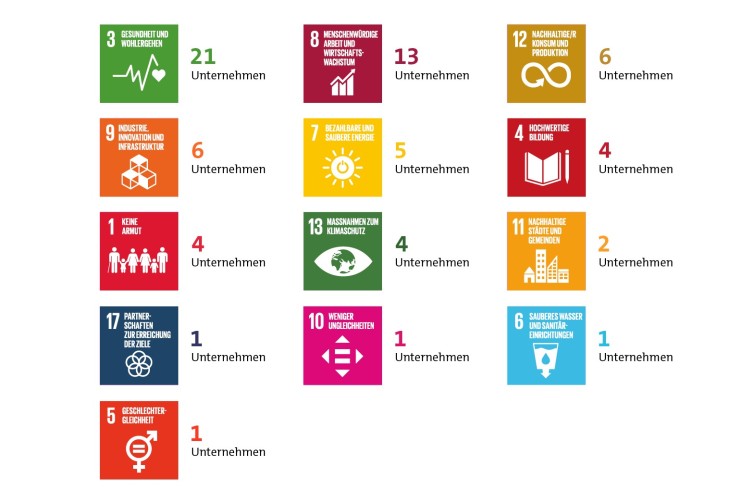
Beyond this immediate impact of the fund in the area of economic development, the business activities of a high proportion of the financed start-ups achieve an indirect effect with regard to the SDGs. The emphasis lies in the areas of Health, Decent Work and Economic Growth, Responsible Consumption and Production, Education, Sustainability and Energy.
Focus on female founders
IBB Ventures is a member of the #startupdiversity initiative of the Start-up Association and bitkom. The aim of the initiative is to strengthen female founders in the start-up ecosystem. The proportion of female founders in Germany currently stands at merely 19.8 %, and only 15 % of venture capital financings involve female or mixed teams. At IBB Ventures, however, since the launch of the current funds, almost 20 % of financed start-ups have had at least one female founder in the founding team.
Impact investing
In 2022, the existing fund offering was expanded to include an Impact VC Fund. This fund targets start-ups whose business activities are not only focused on commercial success, but also make a measurable, positive contribution to addressing the most pressing societal challenges. The focus lies on the SDGs. The investment focus of the fund will therefore presumably lie primarily in the areas of
- Good Health and Well-being (SDG 3),
- Quality Education (SDG 4),
- Gender Equality (SDG 5),
- Affordable and Clean Energy (SDG 7),
- Industry, Innovation and Infrastructure (SDG 9),
- Sustainable Cities and Communities (SDG 11),
- Responsible Consumption and Production (SDG 12), and
- Climate Action (SDG 13).
The Impact VC Fund has a volume of EUR 30 million. 60 % of the fund resources derive from returns and proceeds from successful participations of IBB Ventures, with the remaining 40 % coming from ERDF funds of the European Union for the funding period 2021 to 2027. The Impact VC Fund also aims for continuity of the fund offering through reinvestment of returns and proceeds, as well as leverage through joint financing with private investors. This presupposes an appropriate relationship between possible returns and risk for the financed companies.
Case studies on the work of IBB Ventures
-
SDG Goals 1 & 3
Elucid was founded in 2022 and enables companies to use a cloud-based service platform to ensure farmers in the supply chain have access to healthcare through purchaser-financed preventive care plans, whilst simultaneously reducing their negative impacts and risks in their supply chain.
By providing Health Benefit Packages, access to healthcare is facilitated for farmers in global supply chains, and the risk of falling below the poverty line due to illness is reduced.
-
SDG Goal 9, 12 & 13
Ucaneo is developing a new generation of Direct Air Capture (DAC) technology that mimics the human lung. The company pursues an ambitious and measurable mission: to remove half a gigatonne of CO₂ from the atmosphere by 2035. The heat-free, energy-efficient technology enables flexible operation with renewable energies and supports modular scaling.
Even today, Ucaneo achieves costs below EUR 300 per tonne with a clear path to under €100 per tonne, which has been validated by an independent feasibility study.
The impact of IBB Capital in detail
Promoting entrepreneurship and employment
IBB Capital's activities serve economic development by improving the financing situation of start-ups, thus addressing SDG 8: "Decent Work and Economic Growth."
In addition to this direct impact of the company in the area of economic development, the business activities of a high proportion of the funded start-ups have an indirect impact with regard to a variety of SDGs. The focus is on the areas of health, quality education, economic growth, industry, innovation and infrastructure, sustainability and energy.
Through the “BerlinInnoGrowth” programme (BIG programme) launched in May 2024, IBB Capital makes investments in innovative and fast-growing start-ups in the company's existing portfolio.
By mid-2026, 33 equity investments had already been made, including in the areas of “Health and Well-being”, “Quality Education” and “Sustainable Cities and Communities”.
Status: 1 Jun 2026